
Back in the 20th century, as skiing started catching on with more and more people, many began looking for ways to enjoy snow sports without making the long trip to the mountains. While skiing has long been associated with snowy alpine landscapes, not everyone has had the time, money, or access to travel to traditional ski resorts. This sparked creativity and innovation, leading to a fascinating variety of substitutes that have allowed people to experience the thrill of skiing without setting foot on a mountain. From the first man-made ski slope in the early 20th century to today’s high-tech snow domes and ski simulators, these alternatives tell a story of innovation and the ever-growing passion for snow sports. In this timeline, we take you through the history of skiing alternatives and highlight some of the key events that have shaped their development.
Early Attempts at Indoor Ski Spaces
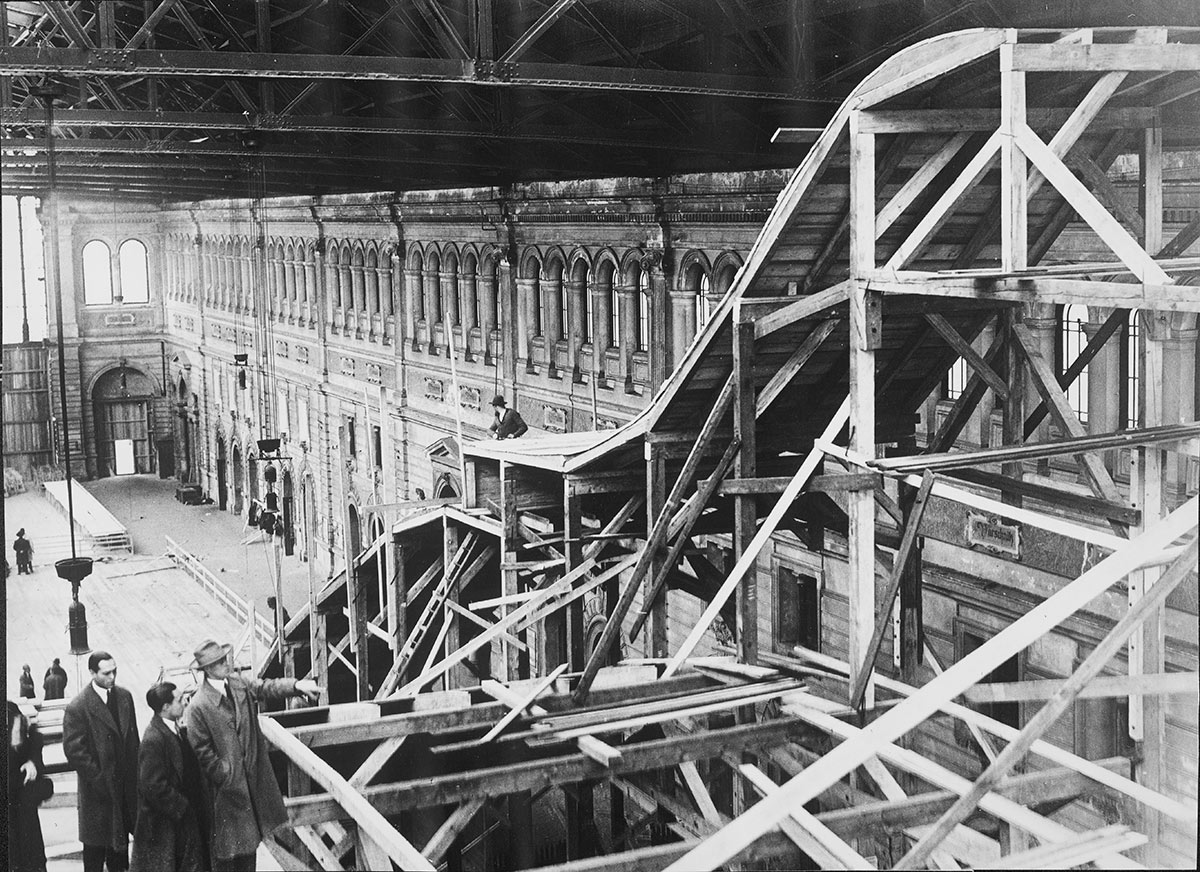
In 1927, the first “indoor snow center” opened temporarily in the Automobilhalle in Berlin, attracting worldwide attention. Later that year, a more permanent facility was established when Dagfinn Carlsen, a Norwegian ski jumper living in Vienna, converted the old Northwest train station into his “Schneepalast” or Snow Palace. The venue featured a giant ski slope built on scaffolding covered with coconut matting, a toboggan run, and a 21-meter / 70-foot indoor ski jump. To create the snow, Carlsen used a mixture of soda and sawdust developed by British chemist Laurance Clark Ayscough. Newspapers described the artificial snow as “white, soft, and slippery as natural snow,” though skiers who fell on the surface reported being able to taste the soda. Carlsen was one of the first to bring mountain skiing indoors, inspiring future innovations in artificial snow. At the Schneepalast’s opening, one report remarked, “With a little imagination, you can believe you are somewhere in the mountains.” Despite its early success, the Vienna center closed after six months when the soda mixture proved less than ideal because it wasn’t slippery enough. In the years that followed, inventors started experimenting with new techniques to better replicate the feeling of real snow.
The First Dry Slope in the UK
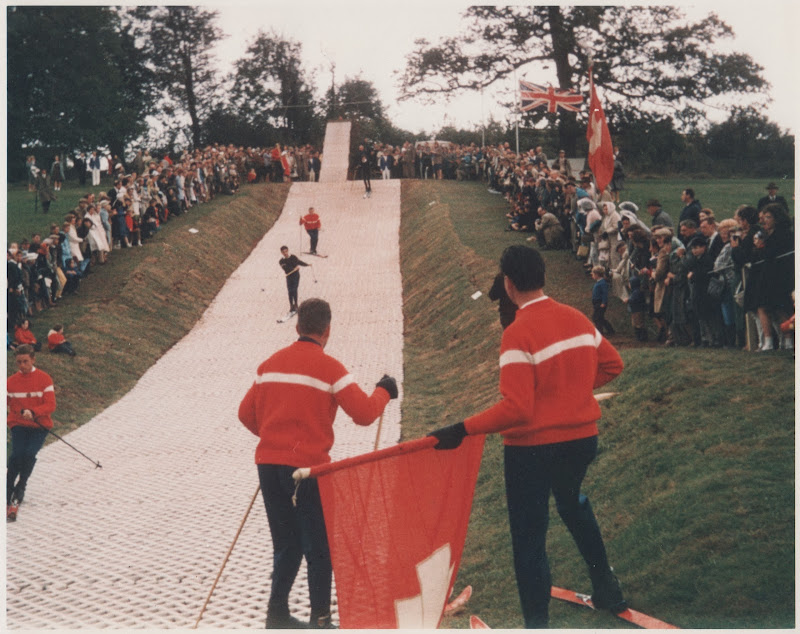
A dry slope is a man-made slope that is covered with a layer of artificial matting. Firms such as Dendix, Skitraxx, and Neveplast were among the first to manufacture these types of surfaces. From molded plastic to upturned bristles, several approaches to ski surfaces exist with a variety of materials, grip, slipperiness, user safety, and durability of the matting. In 1961, Dendix developed ski matting in a hexagonal pattern using strips of bristles. While innovative at the time, the slope offered limited impact protection and sometimes caused damage to ski and snowboard equipment. To improve conditions, operators began lubricating the slopes with water. However, concerns about safety, cost, and quality soon prompted the search for better alternatives. In 1963, a group of visionaries constructed the first permanent dry ski slope in Torquay, Devon, United Kingdom. Earlier dry slopes had been temporary, such as one in London’s Piccadilly in the 1950s, and others for shows and exhibitions dating back to at least the 1920s.
This, however, was the first permanent slope open to the public, and it is still operating today with a thriving local ski club called Torquay Alpine Ski Club. After the slope opened, 150 more followed in the UK (the number peaked in the late 1970s and early 1980s), and hundreds of thousands of Brits learned to ski on these dry slopes. Today, around 60 dry slopes are still operational in the UK.
The opening of the first permanent dry ski slope in 1963 is a major milestone in British skiing and marks the first time that skiing became widely accessible. Since then, hundreds of thousands of people have learnt to ski on these types of slopes, and it all started with the Torquay slope and the club that operates it. The heart of our sport in the UK is based around clubs, and it's great to know that this club is still going strong after 50 years.
Ski Villa: a Giant Dry Slope Made from Plastic Tiles
In the long history of developing non-snow surfaces for skiing, one of the most ambitious projects was Ski Villa a ski center created in California’s Carbon Canyon. Opened in 1966, Ski Villa was one of the largest dry slopes ever built and was likely the biggest in the world at the time. Their approach to making an artificial ski surface was, to say the least, quite remarkable. The slope consisted of 1.3 million interlocking plastic tiles, each measuring 15 cm² / 6 inch², with bristles designed to hold skis in place. The concrete slope stretched just under 400 meters / 1,300 feet and covered about 3 hectares / 7 acres, with a maximum vertical drop of 85 meters / 280 feet.
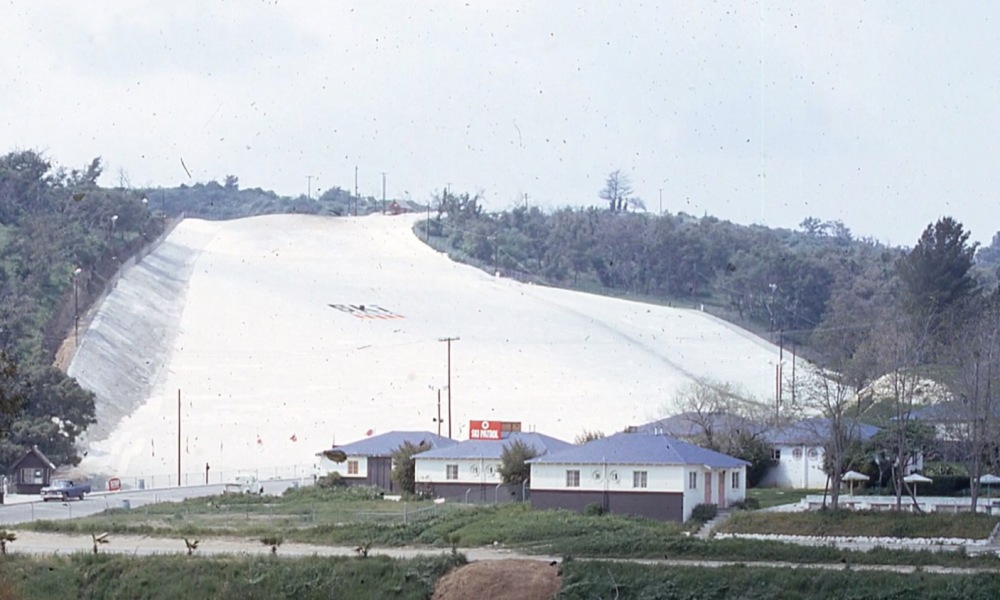
Instead of using a Dendix-style surface from Europe, the ski surface was custom-made by Randazzo, a Californian plastics company based in Gardena. Their patent filing stated that approximately 1,250,000 tiles were required to complete the surface. This design avoided the labor-intensive process of nailing down each tile individually. Each tile, made from Dow polypropylene, featured long bristles and had an expected lifespan of three years. Initially, the surface was laid over asphalt, but melting issues led to a switch to a concrete base. Ski Villa officially opened on July 4, 1966, and early reports described the surface as “like skiing fresh powder.” By the end of the year, it was compared to “mid-morning spring snow” and eventually “hard-packed snow.” By autumn, the center was operating at a financial loss, and it appears the facility did not continue operations into 1967.
A New Approach to Dry Slope Surfaces
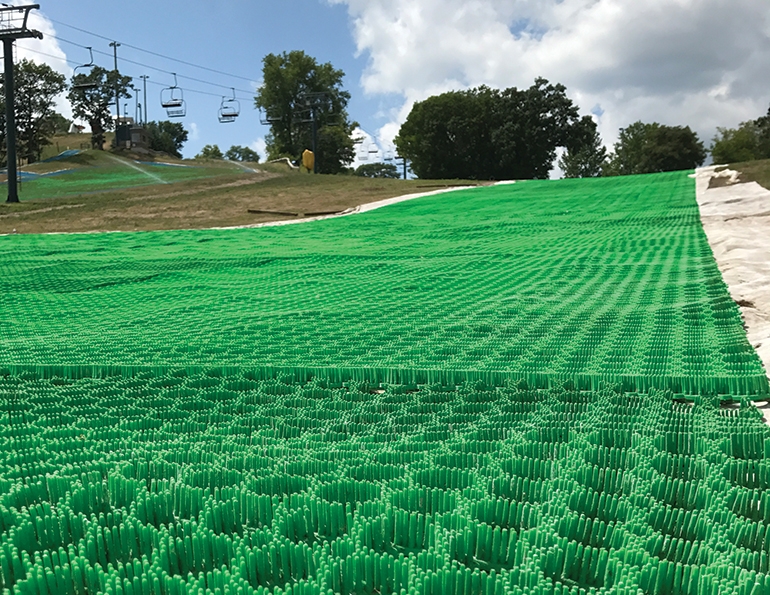
Concerns about safety, cost, and the quality of ski surfaces prompted the search for better alternatives. German manufacturer Skitraxx and Italian manufacturer Neveplast responded with new approaches to artificial ski surfaces. Skitraxx’s 2-pin system, for example, provides fast glide and enhanced grip for carving turns. Before laying the ski matting, a fleece layer is installed as a subsurface, and the SlopeTrax tiles are secured with special twisted pegs. The varying pin heights create a low-friction surface that reduces equipment wear and requires no lubrication. Since 1999, Neveplast has offered the NP30 ski surface, featuring a concentric arrangement of conical stems that eliminates the need for lubricant while enhancing safety and side grip. Together, innovations from companies like Skitraxx, Neveplast, but also Mr. Snow, FG dryslope, PearlSnow and other have greatly improved the durability, safety, and quality of artificial dry slopes, allowing skiing and snowboarding to thrive even in regions far from the mountains.
Ski-Dek: The First Revolving Indoor Ski Slope
By 1962, Schine Enterprises, owners of the Riverside and several small movie houses, had an idea they hoped would start an entertainment revolution: indoor skiing on a rotating artificial ski slope. When Ski-Dek opened in January 1962, the $200,000 center was expected to be the first of many franchises nationwide and worldwide, potentially making indoor skiing as popular as miniature golf or bowling. Newspapers across the country covered what owners hoped would become a new trend.
The principle of Ski-Dek was simple: instead of skiing downhill, the slope moved beneath the skier. The machine was an inclined plane, 5.5 meters (18 feet) high at the top, sloping downward 12.2 meters (40 feet) to a landing strip 1.2 meters (4 feet) off the floor. The platform, 7.6 by 12.2 meters (25 by 40 feet), was covered by an upward-moving rug driven by rollers at each end, functioning like a conveyor belt. A skier moving downward faster than the rug would continue skiing, while a slower skier would be carried to the top. Like Alice in Wonderland, skiers had to keep moving to stay in place. Fun fact: an air-conditioning system blew cool air into the skier’s face to simulate an outdoor-like environment.
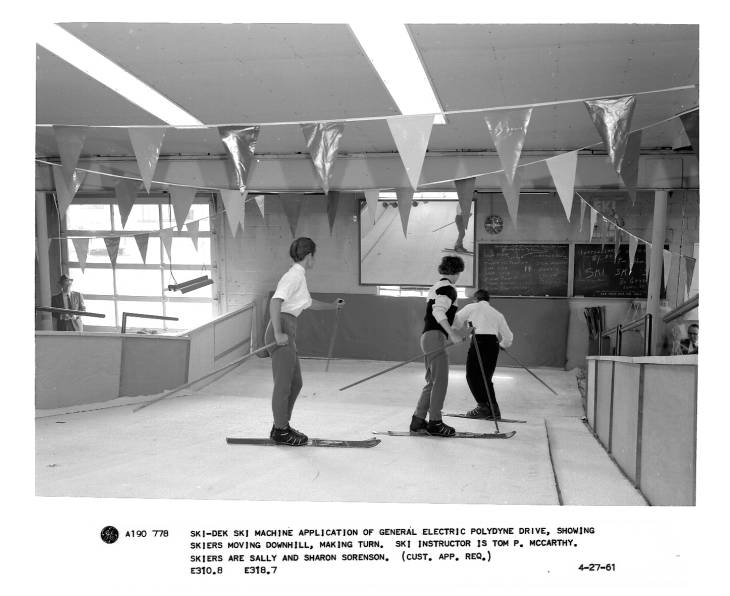
But was it really skiing? “Ski-Dek is to skiing as the driving range is to the golf course,” said champion skier Peter Andrews. “Once you get used to the fact that ‘the mountain’ is moving instead of you, Ski-Dek skiing is remarkably similar to snow skiing.” Even national champions, top instructors as well as complete beginners were tossed by the machine on their first attempts, often ending up staring at the ceiling. Yet, after about half an hour, the strangeness wore off, leaving smiles on the skiers’ faces. Overall, the machine proved to be addictive: no one wanted to stop their session. With no bumps, branches, icy patches, or wet snow, it offered pure, endless enjoyment.
The Rise of Indoor Snow Halls
The modern era of indoor snow centers began when facilities opened in Australia, Belgium, and Japan. These refrigerated halls maintained sub-zero temperatures but lacked real snow, earning a reputation as “sloping ice rinks.” All three centers opened to the public in 1987, and each claimed to be the “world’s first.” It was not until ski centers like Tamworth Snowdome in 1994 and SnowWorld in 1996 that indoor facilities began to recreate the texture of real snow without using crushed ice or additives. Tamworth Snowdome in the UK used a patented indoor snowmaking system developed by Acer Snowmec, claiming to be the first indoor snow center with true, additive-free snow. The owners also trademarked the name “Snowdome” to prevent others from using it. Today, Tamworth remains one of the world’s longest-surviving indoor snow centers.
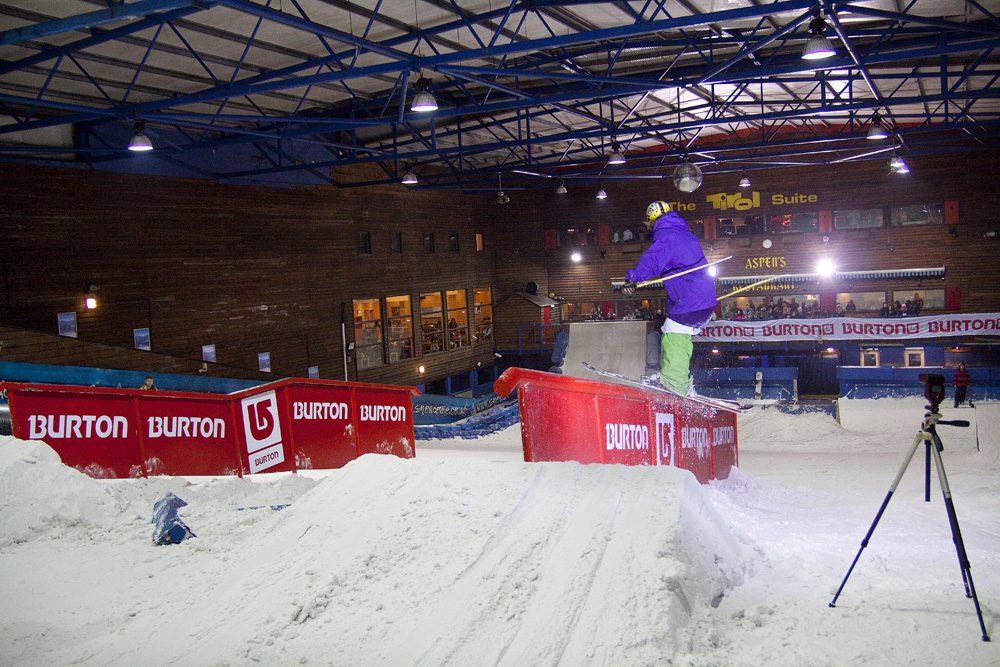
In 2002, SnowWorld opened a massive facility in Landgraaf, which at the time was the largest indoor ski hall in the world. It featured two 387-meter / 1,270-foot runways, a 100-meter / 330-foot competition track suitable for official FIS events, a six-person chairlift, and a cozy “Hütte” in the center of the slopes. From the inside, it felt like the Alps, only the roof took away the illusion. In 2003, the first indoor FIS World Cup took place at Landgraaf, marking a unique milestone in competitive skiing. The center also added a third track ,a fun park, and a fourth, attracting international ski teams and freestyle athletes for summer training. In 2016, SnowWorld expanded its Zoetermeer location with a 300-meter / 984-foot slope featuring a 72-meter / 236-foot vertical drop, making it the steepest indoor slope in the world. Today, SnowWorld stands as one of Europe’s largest operators of indoor ski halls in Europe.
The First SkiMachine
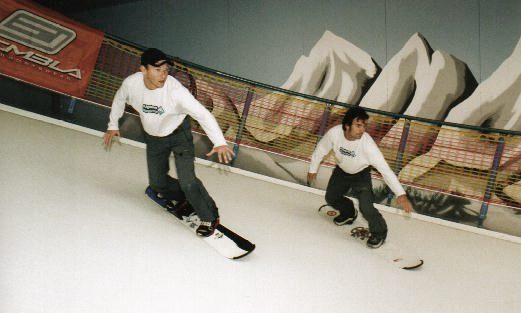
Inspired by the Ski-Dek concept, Alpine Engineering was founded in 1995 when our founder, Rob, set out on an ambitious journey. A skilled snowboarder and mechanical engineer, Rob designed and built two treadmill ski machines and opened his own indoor ski center. The success of these machines quickly generated demand from other centers, prompting him to focus entirely on developing more SkiMachines.
Since then, our expertise in snow sports and commitment to innovation have made SkiMachine the world’s leading manufacturer of indoor ski simulators, with over 250 ski centers worldwide using our technology. Over the years, we have expanded our product range to include larger SkiMachine models, as well as specialized models like the Disc Slope and the Portable SkiMachine. We have improved artificial ski grass, integrated interactive e-skiing tools and video playback systems, and introduced new sports on the revolving slope, including cross-country skiing and cycling.
Today, SkiMachine stands for teamwork, passion, and durability. Simply put, we’re obsessed with snow sports, engineering, and our customers. This passion drives everything we do and allows us to remain the world’s leading manufacturer of indoor ski simulators.
Stay up-to-date with the latest SkiMachine news!
Discover our newest installations, cutting-edge indoor skiing innovations, and more.
Subscribe to our newsletter
